Showing posts with label Science. Show all posts

Tuesday, 21 January 2014

Planting Bamboo Trees

Bam!  Boo!


Yesterday, a flower expert from the Flower Market came into our class to teach the children how to plant a bamboo tree into a pot. Mr. Lin told the children a Chinese New Year story and then went about explaining how to repot the bamboo plant. The children were great listeners and creative artists.

We have sold most of these plants!  All money raised will be donated to help the homeless dogs of Taiwan.

Please enjoy some photos below:


Saturday, 18 January 2014

Structures of Life


STRUCTURES OF LIFE (Science)
 
Overview of the unit:
 
The Structures of Life Unit consists of four investigations dealing with observable characteristics of organisms.  Students observe, compare, categorize, and care for a selection of organisms.  In doing so, they learn to identify properties of plants and animals and to sort and group organisms on the basis of obervable properties.  Students investigate structures of the organisms and learn how some of the structures function in growth and survival.
 
Below is a list of words your children will be taught, and then expected to know.  These words are used frequently so the meaning of them is important.
 
Investigation 1:  ORIGIN OF SEEDS
 
Organism
Property
Reproduce
Survive
Structure
Protect
Dormant
Embryo
Cotyledon
Function
Beneficial
Seed coat
Germination
 
Last week we were learning about the importance of seeds.  Some concept questions we were discussing: 
 
 What is a fruit?
 
What is the function of a fruit?
 
What is a seed?
 
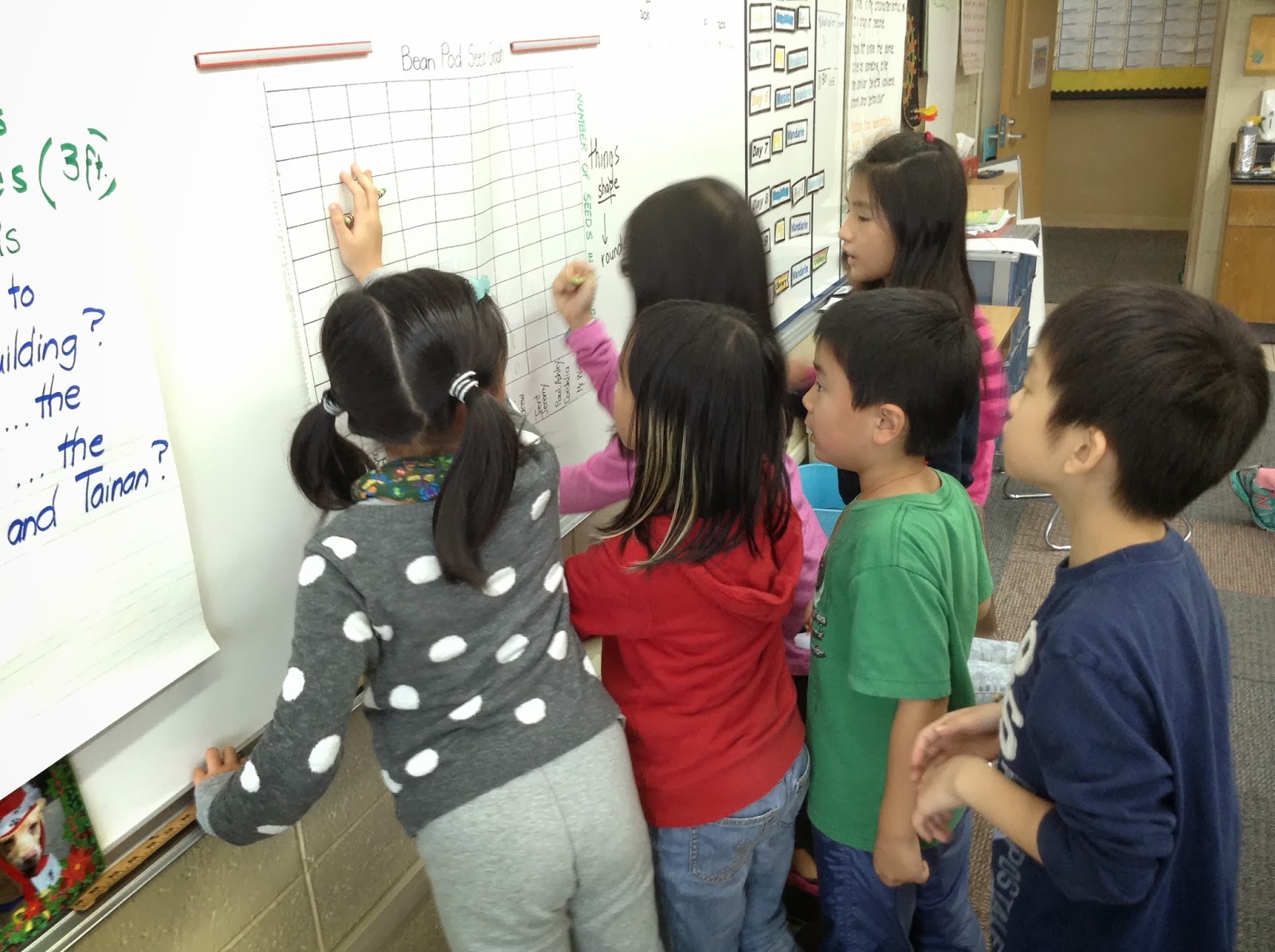
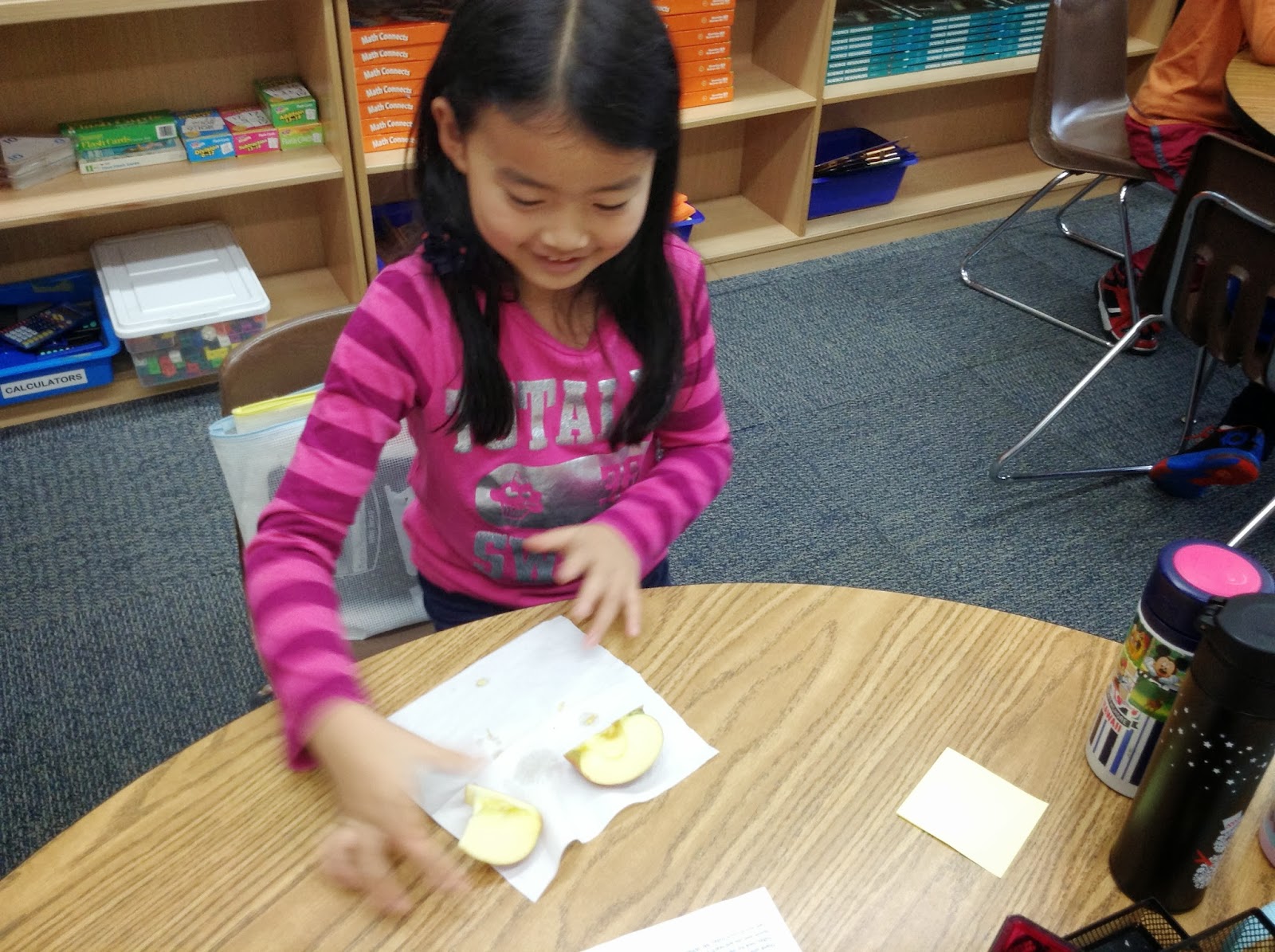
The children and I read some information centered around these questions.  We also cut  some fruit, identified the seeds, described them, counted and plotted them on a graph.


Monday, 9 September 2013

Science

Science in the Sun
Our first science unit in Grade 3 is focusing on the SUN.  Some of the standards that we want children to understand are:
* Students will know the position of the Sun in the sky changes during the course of the day and from season to season.
* Students know sunlight can be blocked to create shadows.
* Predict the outcome of a simple investigation and compare the result with the prediction. 
We took compasses outside and found the directions of North, South, East, and West.


We pointed to where the Sun was during 2:00 pm.  We also pointed where the Sun was early in the morning at 9:15 am.  We discussed what was happening.


We traced our shadows early in the morning.  We predicted in which direction our shadow will be at 9:15 in the morning.  We all faced South and found out that at 9:15 in the morning our shadows will be in the West. We discussed why.

If you have time please ask your children what they know about where the Sun rises, sets and most importantly, what makes this happen.
The children will be given a short test on many of these areas to see if they have understood the concepts.  You will be receiving their test to have a look at soon. 
Some key concepts:

* The Earth spins on its axis

* The Sun rises in the east and sets in the west every day.

* A compass is a tool used to determine directions.

* Shadows are the areas of darkness created when light is blocked by an object.

* The shapes of shadows change over a day and depend on the position of the Sun in the sky.

* Day happens when a location of Earth is facing the Sun.

* Night happens when a location on Earth is facing away from the Sun.

* The exact path the Sun takes in the sky varies by season.  In summer the Sun is higher in the sky.  In winter the Sun is lower in the sky.